
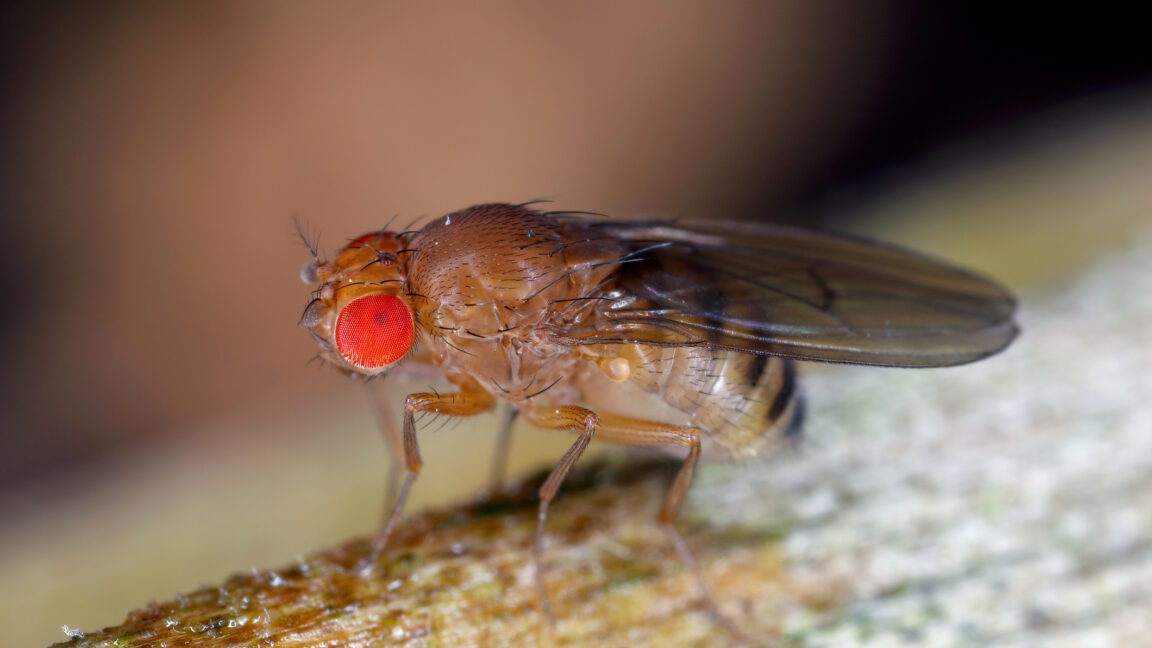
Eating less protein as larvae may limit their ability to produce proteins as adults. Back in the 1930s, scientists noticed that water fleas and rats fed restricted diets while young went on to live longer. The same effect has since turned up in fruit flies and mice. A recent study published in Nature might have found the answer to how a meal eaten in infancy could affect health weeks, months, or even years later.
Nutritional Memory in Fruit Flies
A team led by Fumiaki Obata, a biologist at the RIKEN Center for Biosystems Dynamics Research in Kobe, Japan, discovered a protein that carries a record into adulthood of what fruit flies ate as larvae, influencing their lifespan. Lab fruit flies are typically fed a mix of yeast and sugar, with yeast being their main source of protein.
““We decreased only the yeast concentration in the diet, from eight percent to either one or two percent,” Obata explains.
This low-protein diet was introduced roughly halfway through the larval period. Once the flies emerged from their pupae as adults, they returned to a standard diet. In Obata’s experiment, the protein-restricted flies, both males and females, outlived their well-fed siblings. However, this came at a cost; the flies were paler and lighter, weighing sometimes 28 percent less. The females also laid fewer eggs.
““It’s very common, actually. Reproduction and lifespan are always in a tradeoff relationship,” Obata says. “This is also the case in this early-life dietary restriction. They have fewer eggs and they are slightly smaller. But they have a lifespan extension.”
The Role of Amino Acids
When the team added amino acids back into the low-yeast larval food, the lifespan boost disappeared. This indicated that the adult flies’ bodies were remembering how much protein they had eaten as larvae. Obata and his colleagues termed this phenomenon nutritional memory and set out to identify where this memory was stored in the body.
By comparing gene activity in adult flies raised on low protein and standard diets, the researchers identified around 100 candidate proteins that could store information about early protein intake.
““We basically went one by one, checking which would be important,” Obata says.
To narrow the search, the team tagged the larval food to determine which proteins in an adult fly’s body were built from the food it ate as a larva. Larvae were raised on a synthetic diet where two amino acids, lysine and arginine, were made with rarer, heavier isotopes of carbon and nitrogen atoms. Once the larvae became adult flies, the team switched to food with a second set of amino acids tagged with different, lighter isotopes. They then used mass spectrometry to weigh fragments of proteins from the flies’ heads.