
Kakori Train Action — Complete English Script
“From a young age, we have been taught one thing in this country: that we gained our freedom through non-violence, through Gandhi, through the charkha, and through satyagraha. And this is somewhat true. But not entirely.
The second truth is that there was another Hindustan. Another battle was being fought. It was the battle of the youth who knew very well that these British were so arrogant that merely folding hands or turning the other cheek would neither reform them nor ever lead to freedom for Hindustan.
==This Kakori Train Action is the most important chapter in that second battle.==
Look, there is a city named Lucknow in Uttar Pradesh in our country. And about 15 minutes before Lucknow, there is a small village. There is a small railway station there, named Kakori.
About 150 kilometers before Kakori, there was a city named Shahjahanpur. From there, all ten revolutionary youths boarded this train that day to loot the British treasure.
This train was running on the Saharanpur-Lucknow route.
So, four things are important up to this point.
The first place is Shahjahanpur, from where the revolutionaries boarded the train.
The second place is Kakori station, where we looted the British treasure a little further ahead.
The third place is Lucknow, which is the final destination of this train.
And the fourth, most important thing is that the train's railway number was '8 Down'. That is why everyone called it the 'Number 8 Down Train'.
Imagine this train standing near Kakori. This is its engine part, facing towards Lucknow.
According to the information received, there were a total of six coaches in this train. Besides, there was a guard van and, of course, an engine that was ready to go to its final destination, Lucknow. Only 15 minutes were left to reach there.
The first coach adjacent to the engine was first class. After that, there were three third-class coaches. Then there was a ladies' coach. After that, there was a second-class coach, and at the very end, there was the guard van. In this guard van, a treasure was kept in an iron box.
Looting this treasure was the true purpose of the revolutionaries.
Even during the British era, railway coaches were divided by class. Just like our Indian Railways today, where there are AC, sleeper, and general coaches.
This first-class coach was the most expensive. It was for white sahibs and wealthy people.
The second-class coach was relatively less crowded, comfortable, and had slightly more expensive tickets. Prestigious-looking people traveled in it.
The ladies' coach was exclusively for women.
And these three third-class coaches were the cheapest. Ordinary people traveled in them amidst huge crowds.
Let me clarify one thing honestly. The order of the train's coaches and which revolutionary sat in which coach, I will mention later, is not fully documented in government records.
This is a visual reconstruction based on books written by those revolutionaries themselves and later descriptions.
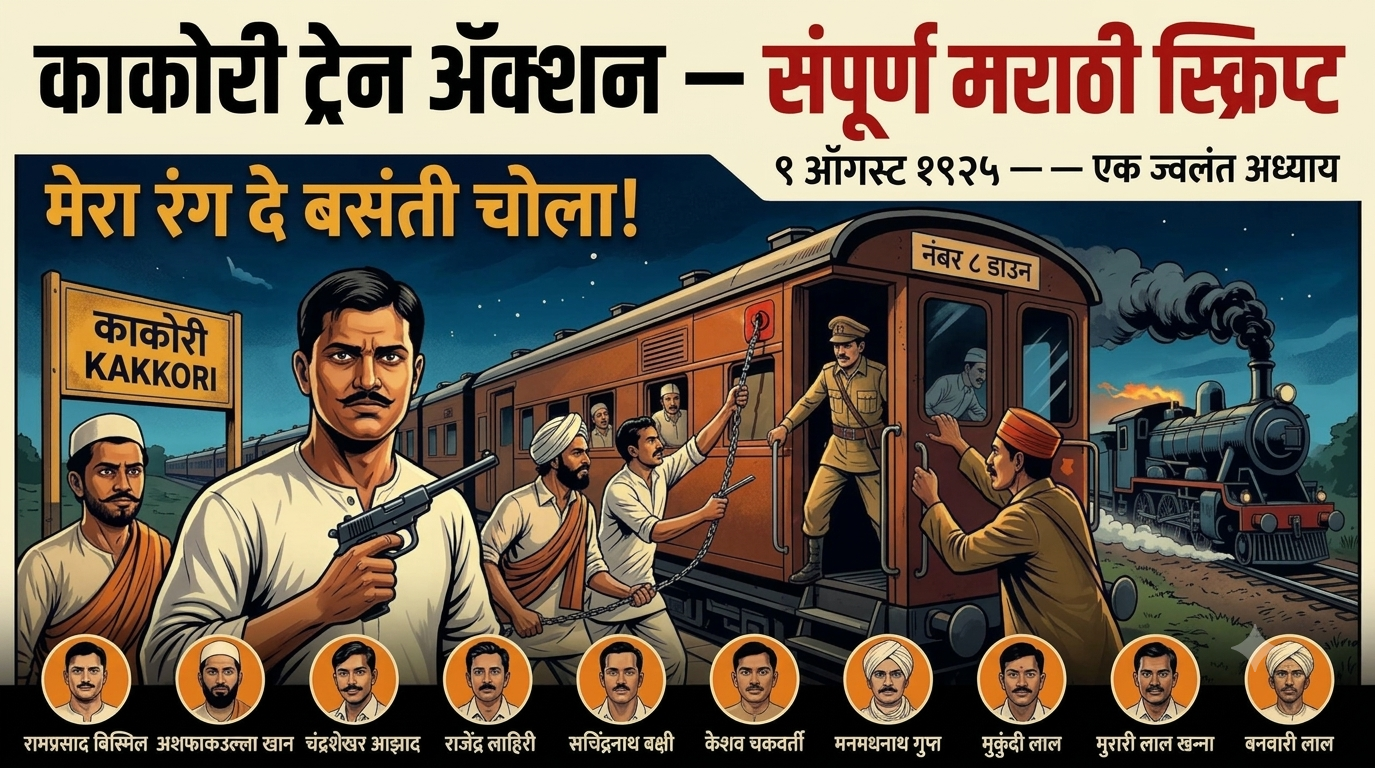
But to understand the story, consider this picture. In a little while, I will tell you which revolutionary hid where in which coach.
Now understand one last thing. Who were those ten steel freedom fighters in our country who showed the British their place and looted the treasure from their own train?
First and foremost was Ram Prasad Bismil, who was only 28 years old. He was the mastermind behind the entire Kakori Train Action. The entire plan was devised under his leadership.
It is said that the famous song 'Mera Rang De Basanti Chola' was created by him during his days in prison with his companions.
And then when he was hanged due to the Kakori Train Action, he went joyfully towards the gallows holding the Bhagavad Gita to his chest.
The second was Ashfaqulla Khan. He was also a very close friend of Bismil. He was only 24 years old. He too was later hanged.
The third freedom fighter is known by every little child in this country. He was Chandrashekhar Azad. At that time, he was only 19 years old.
The fourth was Rajendra Lahiri. He was 24 years old. He was the one who pulled the chain of this train near Kakori.
The fifth was Sachindranath Bakshi. Age 20.
The sixth was Keshav Chakravarti. Age 22.
The seventh was Manmathnath Gupta. He was the youngest, only 17 years and six months old.
The eighth was Mukundi Lal.
The ninth was Murari Lal Khanna.
And the tenth brave freedom fighter in this Kakori Train Action was Banwari Lal.
All of them understood one thing very well: that if India wanted to gain freedom, it would not be achieved by Gandhi's methods.
These young freedom fighters and their companions wanted to drive the British out of this country by violent means. And for that, weapons were necessary.
They had no money to buy weapons because the British were looting everything.
So they planned that since the British were taking the money looted from Indians in the train, they should loot that treasure.
This was the plan of the Kakori Train Action.
And according to this plan, on August 9, 1925, all ten freedom fighters were ready to board the Number 8 Down train from Shahjahanpur Junction.
Before the train left the station for Kakori, remember three things.
The first thing is that there is an iron box in this guard van. Yes, that very box that these freedom fighters are going to loot near Kakori today.
The second thing is that these freedom fighters are boarding the train from both sides. They do not even look at each other. They are going into different coaches so that no British officer suspects anything is wrong.
The third thing is that all of them boarded from Shahjahanpur because it was the hometown of Ram Prasad Bismil and Ashfaqulla Khan. It was here that they had planned the entire Kakori Train Action.
The Number 8 Down train was now finally on its way to Lucknow.
And before the train reached Kakori, understand one thing clearly.
In the second-class coach near the guard van, only three of the ten freedom fighters were seated in the train.
Ashfaqulla Khan, Rajendra Lahiri, and Sachindranath Bakshi.
Think about how accurate this plan was!
These three had bought the proper second-class tickets from Shahjahanpur Junction.
Why?
Because if the guard had even the slightest suspicion, these three could show their tickets like prestigious passengers.
Clean clothes, good manners, just like someone traveling for a government meeting or a business meeting.
Among these three, the most important responsibility was with Rajendra Lahiri, as he was the one who had to pull the train's chain.
Now ahead of this second-class coach was the ladies' coach. No revolutionary was seated in this coach.
But remember a small thing from now on.
In a little while, a small action by a specific passenger heading towards this ladies' coach would give this entire story a twist that people would talk about for the next 100 years.
But for now, let's move ahead.
In front of the ladies' coach were three third-class coaches. In these three coaches, the remaining seven freedom fighters were mixed and seated in different places.
They had neither bought tickets nor pretended to be prestigious passengers. Instead, they were hiding among ordinary passengers in the crowded third class, amidst sweaty travelers, the cries of children, and luggage bundles, just like common passengers.
The masterminds of this entire plan, Ram Prasad Bismil and the only 19-year-old Chandrashekhar Azad, were seated in the same third-class coach.
Both were the most experienced and fearless. They were together so that they could keep the reins of strategy in their hands once the action began.
The youngest, 17 years and six months old Manmathnath Gupta was hiding in the second third-class coach.
In his hands was that heavy German Mauser pistol. It did not even fit properly in his small hands.
Remember this Mauser pistol because the most tragic moment in this entire story would occur due to a bullet fired from this very pistol.
Now the story related to that ladies' coach will also come forward.
The remaining four revolutionaries were also seated in different places in these third-class coaches.
That means there were two or three revolutionaries in each third-class coach. After pulling the train's chain, one person would come out from each coach and take their place around the train, creating an atmosphere of gunfire as if a large gang of robbers had surrounded the entire train.
Finally, the Number 8 Down train was speeding towards Kakori.
With every second, that moment was approaching when Rajendra Lahiri's hand would go towards the emergency chain.
Now listen carefully because the real event was about to begin.
Ram Prasad Bismil wrote in his autobiography about this moment that when the train blew its whistle and left Shahjahanpur station, he closed his eyes and began chanting the Gayatri mantra.
Just think. The heart of the person who was the mastermind of the entire plan was also beating loudly.
As Bismil saw the Kakori station sign in the distance, his breaths began to quicken.
The train stopped at Kakori station as usual and moved ahead.
When the train passed Kakori station, a strange incident occurred in the second-class coach.
This entire incident has been written by Sachindranath Bakshi in his own account.
Bakshi quietly asked Ashfaqulla Khan, “Where is my jewelry box?”
Ashfaqulla immediately replied, “Oh, we left it back in Kakori!”
Now you might wonder, what is going on? What jewelry? What box?
In fact, this was not an ordinary conversation. It was a code word.
As soon as this sentence came out of Ashfaqulla's mouth, Bakshi got up from his seat and pulled the emergency chain of the train.
And at that very moment, Rajendra Lahiri also pulled the chain from the other side.
Yes, in most books, the credit for pulling the train's chain is given only to Rajendra Lahiri. But according to Bakshi's own account, on that day, the chain was pulled simultaneously from both sides.
As soon as the chain was pulled, the train's brakes were applied automatically. The iron wheels screeched against the tracks, and with a loud noise, the massive train stopped a little ahead of Kakori, at the place predetermined by the revolutionaries.
Now, in less than half an hour, what was about to happen, I will call it — a miraculous cinematic scene!
As soon as the train stopped, Bakshi, Ashfaqulla, and Lahiri got down from the second-class coach and started walking towards Kakori leisurely.
As they moved a little ahead, the train's guard came in front of them.
He asked, “Who pulled the chain?”
Then he signaled the three to stop right there.
Now listen to Bakshi's answer.
“Our jewelry box was left at Kakori station. We are going to get it.”
That is, the very sentence that was used as a code word fooled the guard as well.
But now the play was over.
By then, all the other revolutionaries had also gotten off the train and reached there. Gunfire erupted in the air.
At the same time, it was announced that no passenger should get off the train.
Meanwhile, Bismil drew his pistol and shouted, “Stay calm! There is no need to be afraid. We have only come to take the money from the government that belongs to us. If you stay seated in your places, you will not be harmed.”
At the same time, Bakshi's gaze fell on the guard. He was secretly preparing to show the green light to move the train forward.
Imagine, if the train had moved forward, the entire plan would have failed right there.
Bakshi pointed his pistol at the guard's chest in one swift motion and snatched the green light from his hand.
The guard began pleading, “Spare my life!”
Bakshi pushed him down to the ground and said, “Lie down facing the grass.”
The British government's guard was lying on the ground with his face down, and the youth of Hindustan were now standing in front of that iron box.
Now in front of them was the object for which the entire Kakori Train Action was planned.
That is, an iron box filled with money.