
Also: Spooky action at the LHC, Ice Age psychoactive use, yeast for building homes on Mars, and more. It’s a regrettable reality that there is never enough time to cover all the interesting scientific stories we come across. So every month, we highlight a handful of the best stories that nearly slipped through the cracks.
Dark Matter Hint at LUX-ZEPLIN Detector
September’s list includes a tantalizing hint of the elusive dark matter at the LUX-ZEPLIN detector. Physicists believe dark matter makes up roughly 85 percent of matter in our universe, with the strongest candidate being weakly interacting massive particles (WIMPs). However, directly detecting WIMPs has eluded physicists for decades.
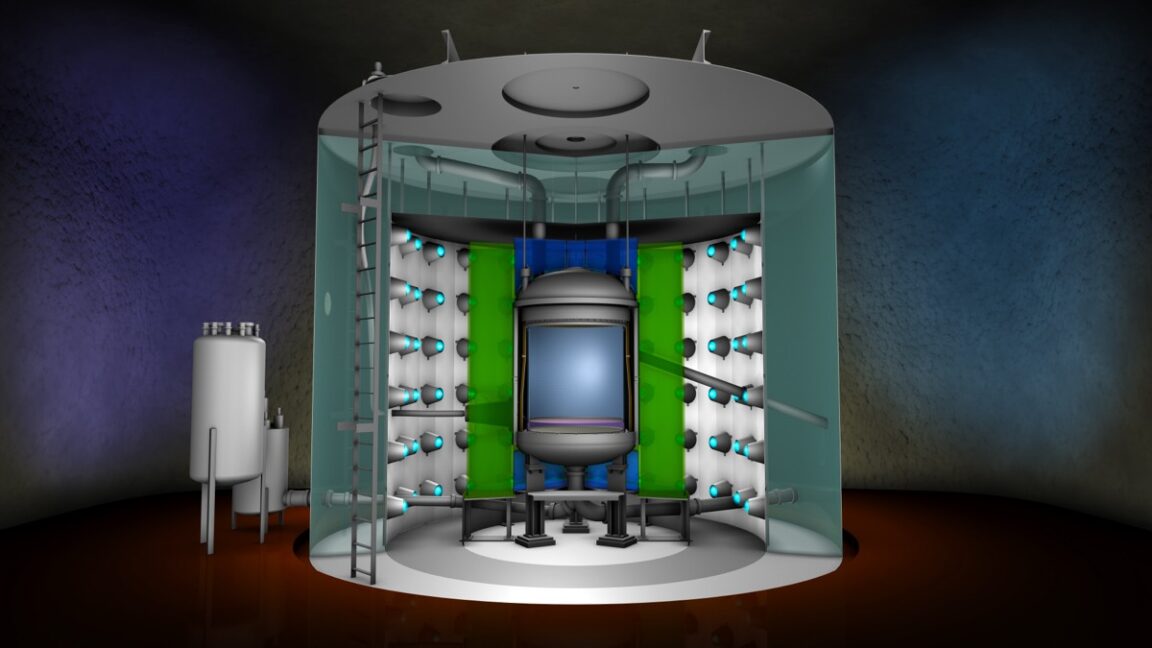
We might have our first glimpse, courtesy of the LUX-ZEPLIN detector buried deep in a gold mine in South Dakota. Those potentially exciting results were presented at the 2026 TeV Particle Astrophysics conference in Japan, with a preprint available on arXiv. The announcement came with strong caveats: the signal is just a hint, well below the threshold needed to confirm discovery, and might just be a statistical fluke.
“"Anyone who regularly follows dark matter news knows that past tantalizing anomalies evaporated as more data came in," the researchers noted.
The LUX-ZEPLIN team is still collecting data, as is the XENONnT at the Gran Sasso National Laboratory in Italy. If it turns out to be a WIMP that struck a xenon nucleus, it’s not what physicists would predict, as the event had a higher nuclear recoil energy than expected.
Quantum Entanglement at the LHC
In 2023, physicists found evidence of entanglement between pairs of top quarks produced at the Large Hadron Collider’s ATLAS experiment. Now, ATLAS physicists have observed entanglement in pairs of Z bosons, according to a paper published in the journal Physical Review Letters.