Introduction
Data flow is one of the most important architectural decisions a frontend framework makes, since it determines how state moves through an application, how predictable that state is, and how easy the resulting code is to debug. React and Angular, two of the most widely used frontend frameworks, approach this problem in fundamentally different ways.
React's Unidirectional Data Flow
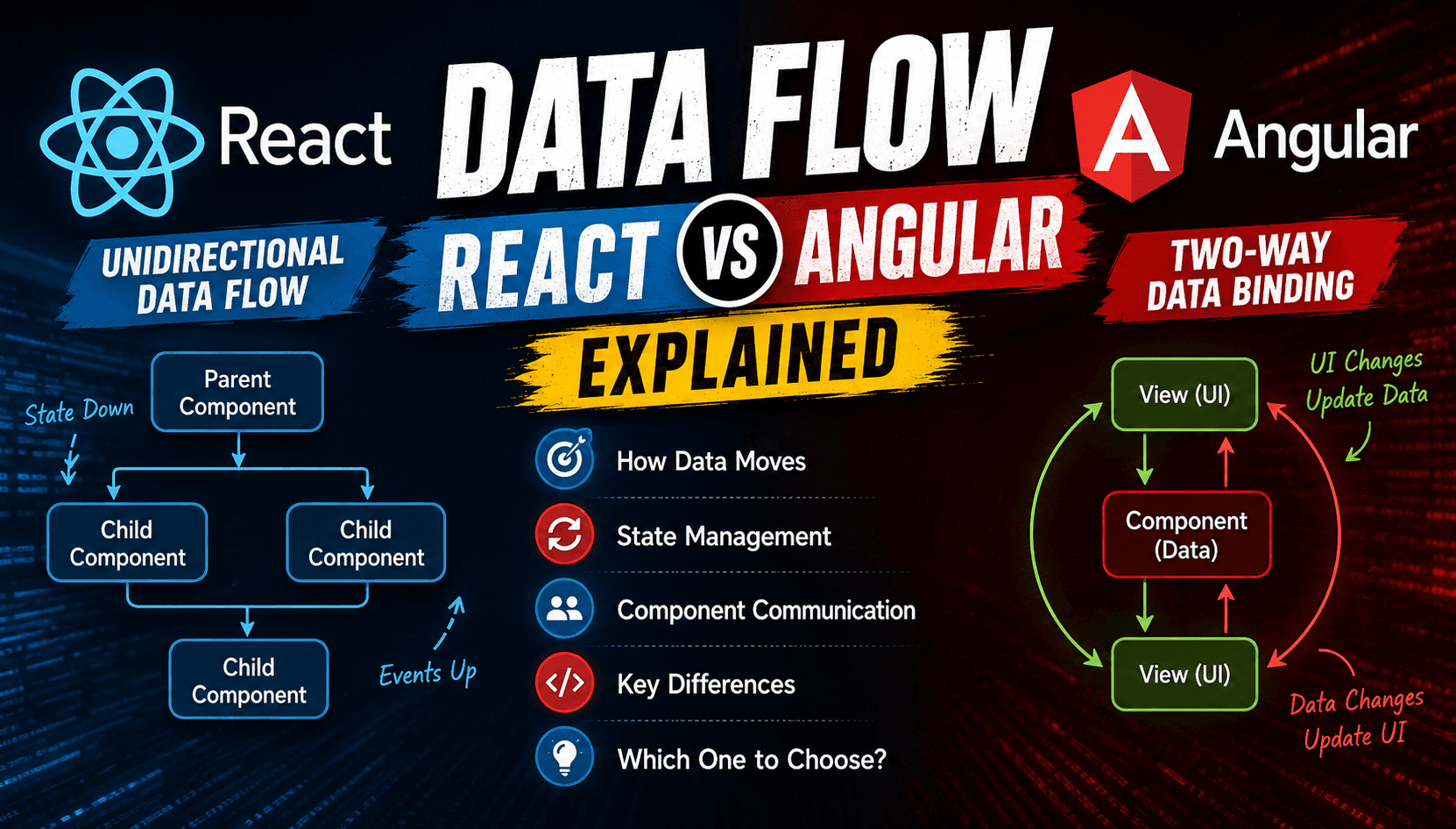
React follows a strict unidirectional (one-way) data flow model, where data moves from parent components down to child components exclusively through props. State lives in a single source of truth, typically the nearest common ancestor component or an external store, and any update to that state triggers a re-render that flows downward through the component tree.
Because child components cannot directly modify the props they receive, communication back up the tree happens through callback functions passed down from the parent. This pattern keeps the direction of data movement predictable: state changes at the top, and updates cascade down, never sideways or upward without an explicit callback.
State Management in React
For local component state, React relies on hooks such as useState and useReducer. As applications grow, prop drilling through many layers of components becomes cumbersome, which is why React offers the Context API for sharing state across a subtree without manually passing props at every level. For larger applications, external libraries such as Redux, Zustand, or Recoil are commonly layered on top to manage global state in a more structured way, while still preserving the underlying unidirectional flow philosophy.
Angular's Two-Way Data Binding
Angular, by contrast, is built around two-way data binding, most visibly expressed through the ngModel directive. In this model, changes in the UI automatically update the underlying component data, and changes in the component data automatically update the UI, without requiring the developer to write explicit synchronization code.