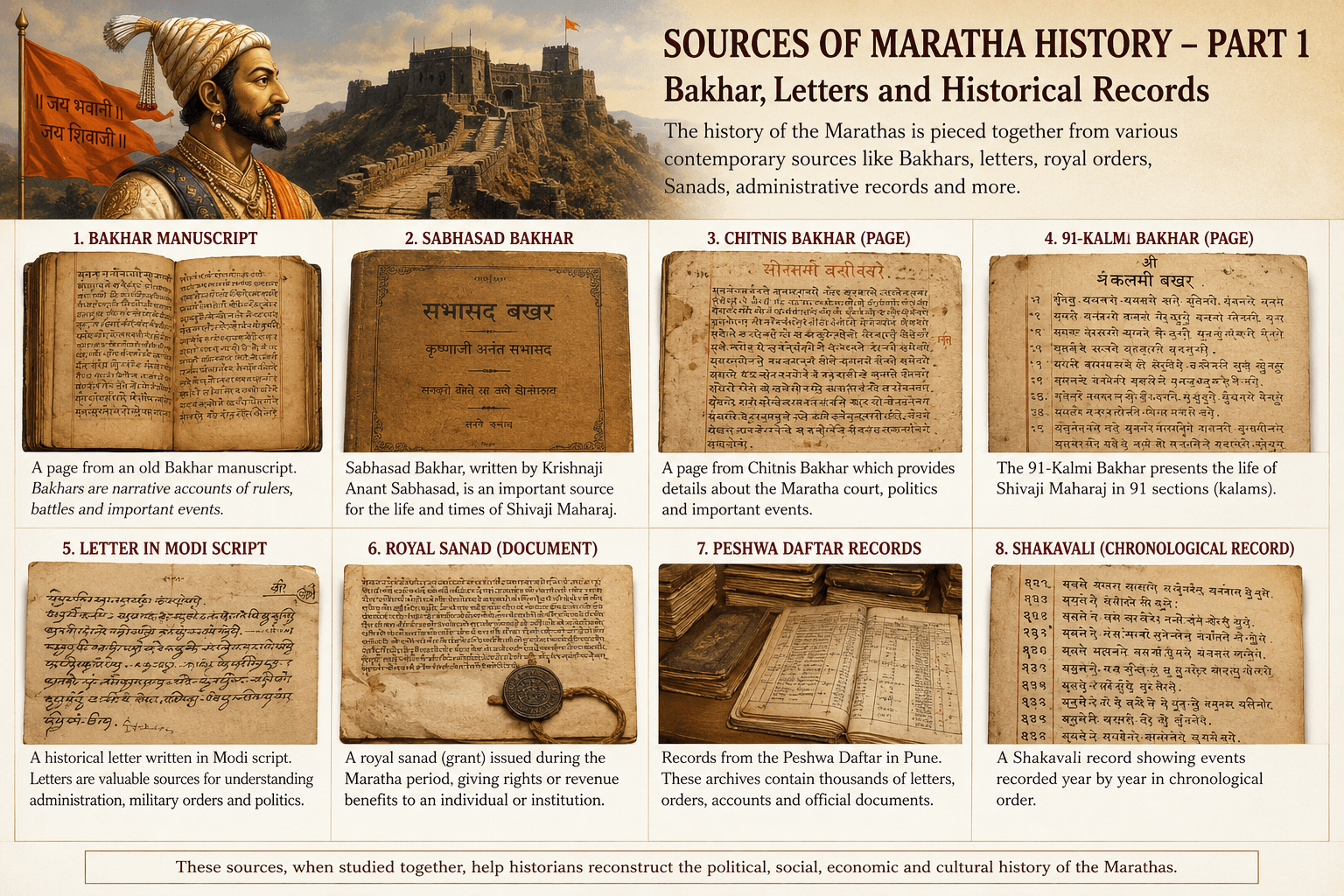
When we talk about Maratha history, images of Chhatrapati Shivaji Maharaj, Raigad, forts, the Mavlas and the rise of Swarajya naturally come to mind.
But there is a basic question we should ask first:
How do we actually know all this happened?
It is not simply because someone wrote a story about it centuries later. We know because people from that period left behind letters, administrative records, royal orders, grants, manuscripts and other forms of evidence.
And this is where the study of historical sources becomes important.
History is not just a collection of interesting stories about kings and battles. It is an attempt to reconstruct the past using evidence.
In the case of Maratha history, there is no single book that tells us everything. We have to put together information from Bakhars, letters, Sanads, administrative records, Persian documents and many other sources.
In this first part, we will focus mainly on the Marathi and administrative sources of Maratha history.
What Are Historical Sources?
In simple terms, historical sources are the evidence through which we learn about the past.
They can broadly be divided into two categories:
| Primary Sources | Secondary Sources |
|---|---|
| Created during or close to the period being studied. | Written later by historians and researchers. |
| Letters, Sanads, Bakhars, royal orders, coins, inscriptions, official records. | History books, research papers, biographies and academic studies. |
For understanding Maratha history, primary sources are particularly important because they bring us closer to the actual period being studied.
And this brings us to one of the most famous sources of Maratha history — the Bakhars.
Bakhars: One of the Most Famous Sources of Maratha History
If you have read anything about Maratha history, you have probably come across the word Bakhar.
A Bakhar is broadly a historical narrative written in prose, usually dealing with rulers, battles, political events or important personalities.
During the Maratha period, Bakhars were one of the ways in which important events and political developments were recorded.
What do Bakhars tell us?
They contain information about:
- Military campaigns
- Battles and political conflicts
- Forts and conquests
- Important rulers
- Court politics
- Administration
- Major events in the lives of Maratha rulers
However, there is one important point to remember:
“A Bakhar is not Wikipedia, and it should not be treated as an unquestionable historical record.
Some Bakhars contain exaggerations, legends, political bias and glorification of particular rulers or families.
That does not make them useless. Quite the opposite — they are extremely valuable.
But historians read them critically and compare them with other sources.
Sabhasad Bakhar: An Important Source for Shivaji Maharaj's History
One of the most important Bakhars associated with the history of Chhatrapati Shivaji Maharaj is the Sabhasad Bakhar, traditionally attributed to Krishnaji Anant Sabhasad.
It was written during the reign of Chhatrapati Rajaram Maharaj and is considered one of the important relatively early narrative sources for Shivaji Maharaj's life and career.
What does the Sabhasad Bakhar contain?
It provides information about several important events, including:
- The rise of Shivaji Maharaj
- The establishment and expansion of Swarajya
- The Afzal Khan campaign
- The encounter with Shaista Khan
- The Agra episode
- Military campaigns
- The coronation of Shivaji Maharaj
- Various aspects of his rule
Because of its relatively close connection to the period, historians give it considerable importance.
But even here, caution is necessary.
The author was connected to the Maratha court, and the narrative naturally reflects the political environment in which it was produced.
So historians do not simply read the Sabhasad Bakhar and declare, "Done, history is solved."
They compare it with other contemporary evidence.
Chitnis Bakhar
The Chitnis Bakhar, associated with Malhar Ramrao Chitnis, is another important source used in the study of Maratha history.
It contains accounts relating to Shivaji Maharaj and the Maratha royal family.
Why is it useful?
It provides:
- Narratives of important political events
- Descriptions of personalities
- Accounts of military campaigns
- Information about the Maratha royal household and political environment
However, questions concerning its date, composition and later transmission mean that historians use it carefully.
As with other Bakhars, it is best understood alongside other independent sources.
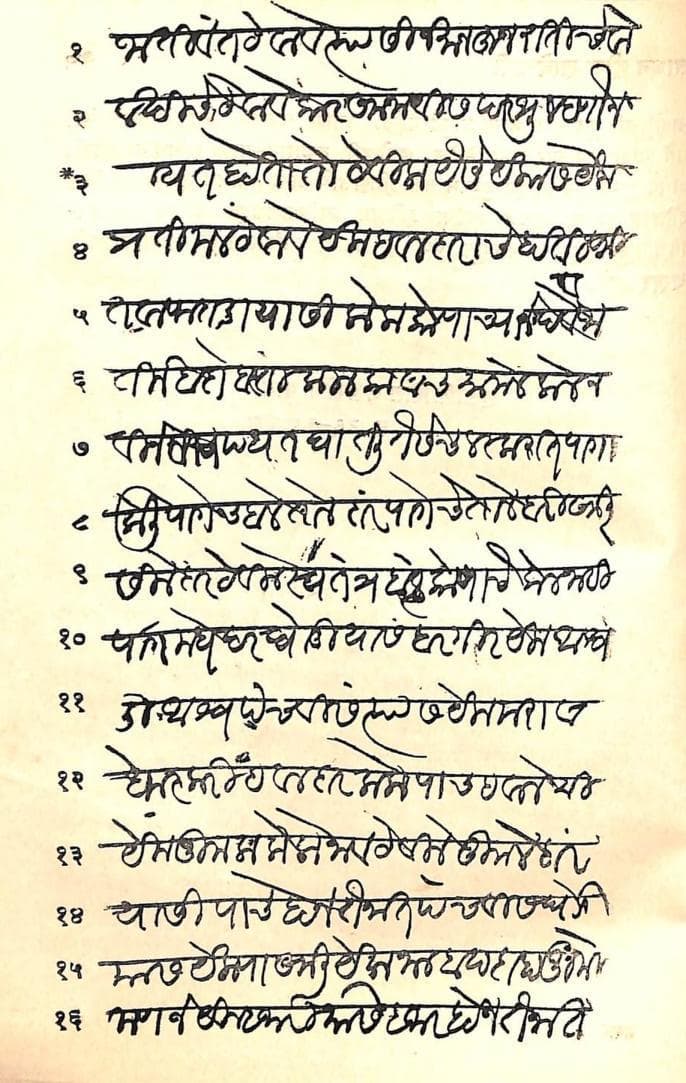
The 91-Kalami Bakhar
The 91-Kalami Bakhar is another source associated with the history of Shivaji Maharaj.