
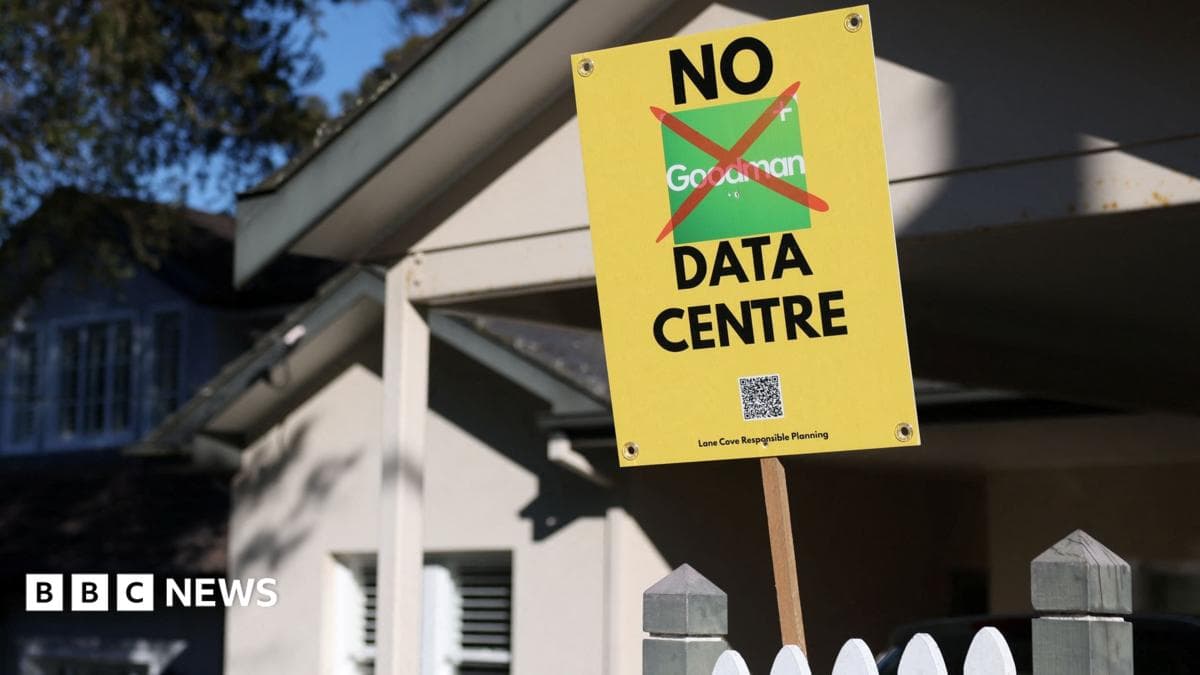
Locals in the Sydney suburb of Lane Cove are concerned about the planned construction of four new data centres. The sheer size and noise of data centres are what people tend to notice first. Some say they sound like a jet plane about to take off, while others complain of a high-pitched whine. When Lucy puts her child to bed, she hears a constant humming.
“"I'll hear it and think, 'What is that? What is going on?'" she says. And then she'll remember that the noise is a data centre just 350m (0.2 miles) from her front door in the desirable suburb of Lane Cove, in Sydney's lower north shore. Another four are in the pipeline at the local industrial park.
Australia has quickly become a global destination for data centres, with investors attracted to the country's abundance of clean energy, natural gas reserves, and land to power and house their technologies. Earlier this year, OpenAI's CEO Sam Altman said Australia could become a data centre capital of the world, if it wanted to.
Current Landscape
Australia is already headed in the direction of big tech's wishes. There are 162 data centres across the country, with plans for 90 more, and an estimated more than A$155bn (£80bn) of investment money lined up. If approved, one of the world's biggest data centres will be built in western Sydney. At one gigawatt, it is expected to be Australia's largest single energy user. In Marsden Park, also in western Sydney, the biggest data centre in the Southern Hemisphere is already under construction only 100m away from a local community.
But as more Australians find themselves living next door to data centres, triggering concerns about water supplies, energy use, and the environment, many are asking whether joining the artificial intelligence (AI) race is worth it.
The Importance of Data Centres
Data centres have been essential to the digital economy since the arrival of the internet. They were originally built to process and store data for things like emails, online banking, and cloud services. However, everything changed after 2022 when ChatGPT launched and AI exploded in popularity. This prompted a sudden race to build more data centres to power the technology.
The location of these large, windowless buildings filled with beeping servers and cables also became important to latency – the time it takes for data to travel from its source to its destination. Delays for things like air traffic control, robotic surgery, or even Netflix would not be tolerated today, says Belinda Dennett, CEO of Data Centres Australia.
Australia has roughly 13.6 million users of AI every month, making them the sixth most active users of the tech globally. Experts say having data centres in Australia will lower the barrier to building more of its own AI companies.
“"If we think about it in reverse, what happens if we don't build infrastructure here? We get none of the value chain, we are just importing tools from someone else and we become just a user," Dennett says.


