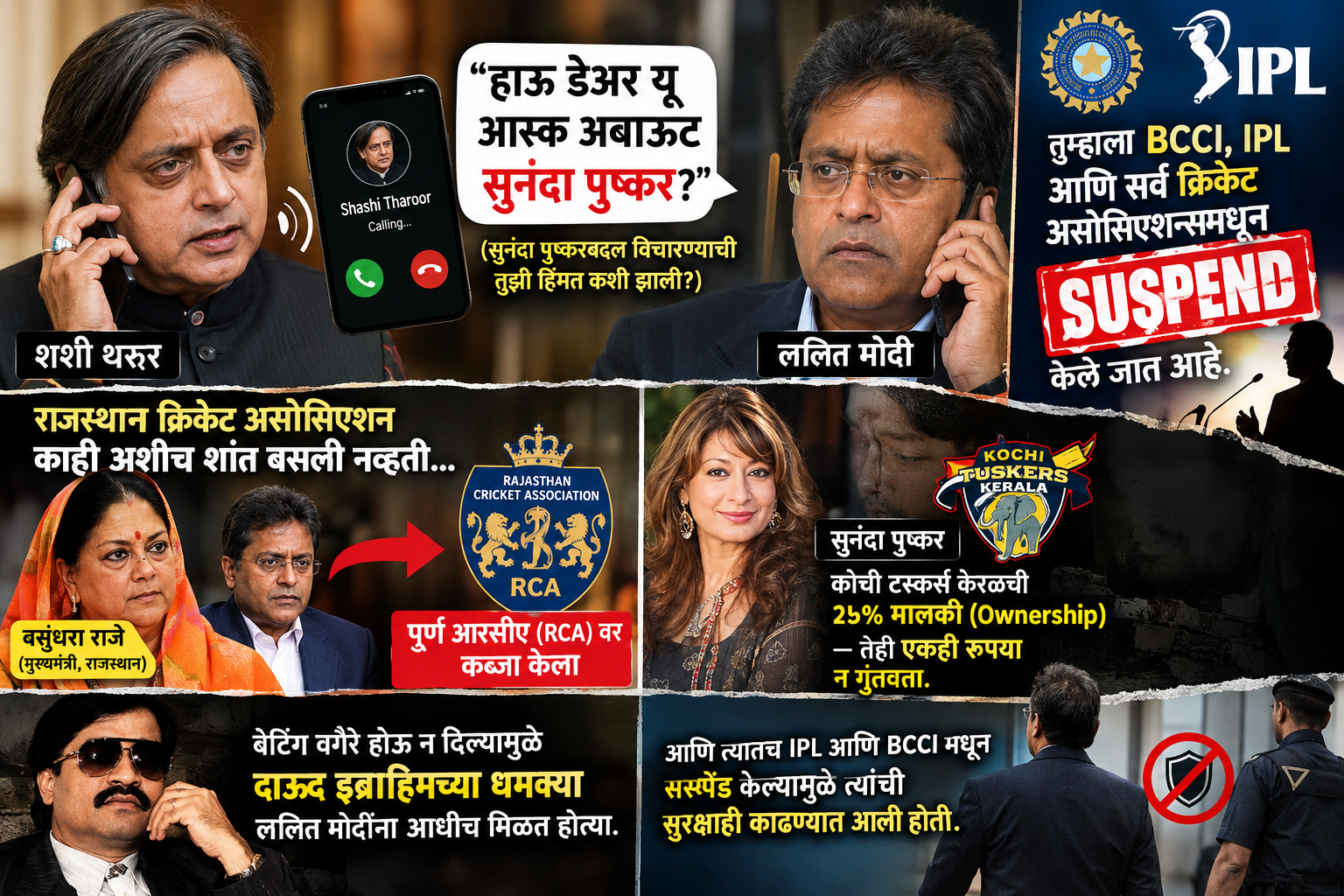
“Shashi Tharoor calls and asks Lalit Modi, ++"How dare you ask about Sunanda Pushkar?"++ (How did you have the courage to ask about Sunanda Pushkar?). And at the same time, just moments before giving a speech, he is informed that he is being suspended from BCCI, IPL, and all cricket associations.
Now, it is important to understand that the Rajasthan Cricket Association was not just quietly sitting by while Lalit Modi took control. They, along with Chief Minister Vasundhara Raje, completely took over the RCA (Rajasthan Cricket Association). It is not that only threats were made over the call, and later, when further investigation was done, it was found that Sunanda Pushkar had a 25% ownership of Kochi Tuskers Kerala, without investing a single rupee.
On the other hand, due to not allowing betting, Lalit Modi was already receiving threats from Dawood Ibrahim. Moreover, his security was also withdrawn due to his suspension from IPL and BCCI.
++IPL: An Empire and Its Rejected Creator++
We all know well that today IPL has become so big that ++sponsorship revenue, media rights, ticket sales, digital streaming viewership++ and all combined involve thousands of crores of rupees. In fact, the brand value of IPL has surpassed 12 billion US dollars.
But did you know?
Thirty-one years ago, when Lalit Modi went to BCCI with this idea, BCCI rejected his idea. Lalit Modi is the same person whom the Indian government still considers a 'fugitive' in 2025. He is the same person who gave birth to a sports league like IPL that created a stir in our country. He is the same person who was threatened with death by Dawood Ibrahim. That is why he fled the country and still resides in London.
++The Early Journey: Wealth and Rebellious Attitude++
Today we will understand the story of Lalit Modi, the son of an ultra-rich businessman, from being an ordinary businessman to infiltrating BCCI and launching IPL. But as always, let's start from the beginning.
The story is from 1963. Nearly 62 years ago, Lalit Modi was born into a Marwari Baniya business family. The Modi family ran 'Modi Enterprises'. To put it simply, their business was in various industries like tobacco, pan masala, education, and chemicals. Lalit Modi comes from a very wealthy (Ultra Rich) family. This can be gauged from the fact that the city of 'Modinagar' in Uttar Pradesh was established by Lalit Modi's grandfather.
In fact, Modinagar was originally named 'Begamabad'. But in 1933, after establishing a sugar mill there, the Modi family developed the entire area and then renamed it Modinagar.
Lalit Modi's childhood was spent in a lavish lifestyle. His attitude in school was somewhat rebellious (Rebellious). He was not a very disciplined student. For this reason, his parents decided to send him to a boarding school. In 1971, he was sent to Bishop Cotton School in Shimla. However, due to the Modi family's wealth and power, they began to receive threats of kidnapping against Lalit Modi. This led to him being moved from there to St. Joseph's College in Nainital.
++Drugs, Arrest, and Foreign Adventures++
Lalit Modi went abroad for graduation. When he was in his second year of college, he and his three friends planned to buy drugs. The plan was simple - to go to a motel and buy half a kilo of drugs for 10,000 rupees. But the person they were dealing with turned out not to be a real drug dealer. He showed a shotgun, robbed them, and ran away.
Then Lalit Modi and his friends thought that some student had cheated them. In a fit of rage, they beat up a guy. Following this, on March 1, 1985, Lalit Modi was arrested. The charges were - possession of drugs, kidnapping, and assault. The case was quite serious, but Lalit Modi did not go to jail. After this incident, his parents called him back to India, and sadly, he could not complete a single degree. From then on, his image became that of a 'rich brat', meaning a spoiled child of a wealthy father.
++Entry into Business and the Beginning of Disney in India++
After returning to India, he joined the family business, but he found traditional business very boring. Lalit Modi's true passion was - glamour, media, sports, Bollywood, and power control.
In 1993, Lalit Modi started his own company called MEN (Modi Entertainment Network). This company primarily worked in TV broadcasting. The biggest achievement of this company was that MEN signed a 10-year deal with Disney, which gave them the rights to show Disney's TV shows in India. This deal marked the first time Disney shows appeared on Indian television. Or it can also be said that Lalit Modi brought Disney to India.
Then in 1994, MEN signed another major 10-year deal with ESPN, valued at 975 million dollars. Under this deal, MEN began distributing popular sports content like cricket, football, and tennis in India. In a sense, Lalit Modi elevated the level of entertainment by bringing Disney cartoons and ESPN sports to Indian television for the first time.
++The First Idea of IPL and Rejection++
In 1994, Lalit Modi had a vision that was far ahead of its time in the cricket world. He saw that football leagues were very popular in Europe, such as the English Premier League (EPL), where teams are based on cities, top international players are involved, matches are broadcast live on TV, and money flows in abundantly.
Then an idea struck him. If such a big league can exist in football, why not in a cricket-loving country like India? Inspired by this thought, he came up with the idea of IPL. He thought of starting a new format of cricket where each team would represent a city or region. Indian and foreign players would mix in the same team, and everything would be broadcast on TV. Each team would have a private owner with whom people could easily relate (e.g., Shah Rukh Khan, Preity Zinta, etc.).
Modifying this idea, Lalit Modi created the complete blueprint for IPL and presented the idea to BCCI for the first time 30 years ago, in 1995. From this, you can understand that IPL is indeed Lalit Modi's brainchild.
But the problem was that what Lalit Modi had proposed was completely rejected. At that time, the president of BCCI was I.S. Bindra, and the secretary was Jagmohan Dalmiya. Most of the board members were supporters of the traditional cricket structure. BCCI felt that private ownership would commercialize cricket too much, create loyalty issues among players, and money and control could slip out of the board's hands. Thus, Lalit Modi's IPL idea was rejected by BCCI.
++Credit and Credibility (Paisabazaar)++
From this rejection, Lalit Modi learned a very important lesson that having a powerful idea is not enough. Until that idea finds a place in the system, it remains just a piece of paper. And to gain entry into any system, 'credibility' is the most important factor.
This is not limited to the world of cricket; it is also true in our daily lives. Think about it, when you urgently need money, whether for personal work or business. At that time, just having an idea is not enough. Whether you will get a loan depends on your credibility, i.e., your 'credit score'. If your score is low, there is no need to worry. With 'Paisabazaar's credit health service, you can improve your score so that getting a loan in the future becomes easier. Paisabazaar is a trusted platform from where you can get personal loans up to 4 million rupees. The loans available through Paisabazaar come from 30+ RBI-approved banks and NBFCs. This means the entire process is completely safe. Here, loans are available at low interest rates and with low EMI options. The starting interest rate is 10.5%. Disbursal (receiving money) is also fast, and there is no hassle of excessive paperwork.