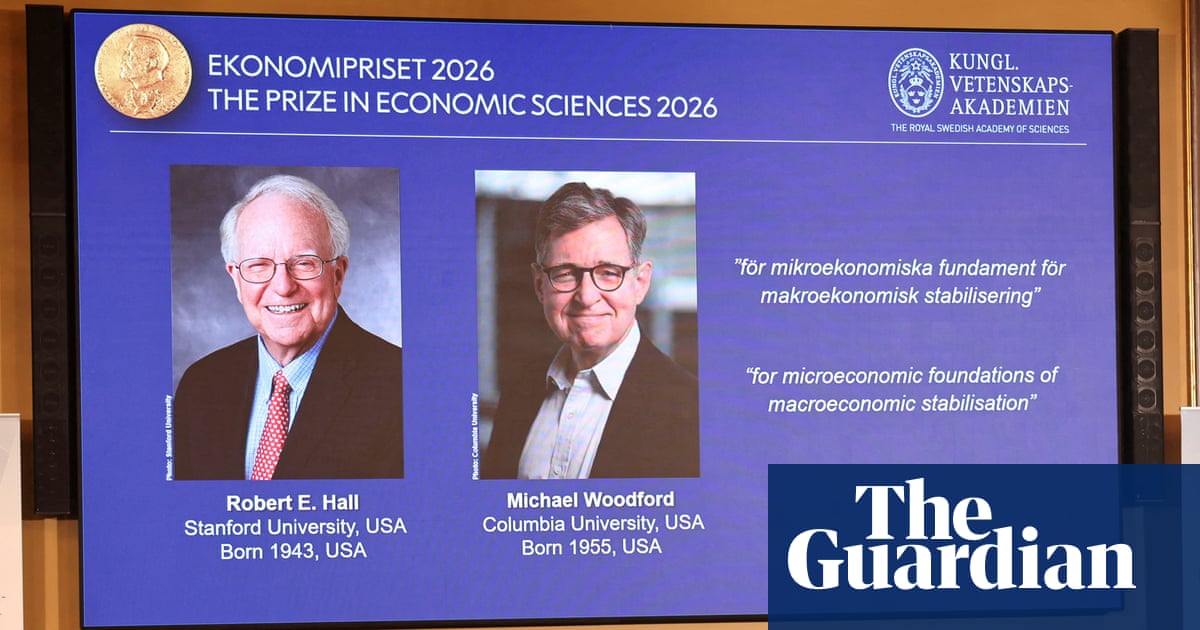
Two US economists, Robert Hall of Stanford University and Michael Woodford of Columbia University, have been awarded the 2026 Nobel Prize in Economics for their groundbreaking work in developing models that assist central bankers and finance ministers in stabilizing their economies. Their research aims to prevent long recessions and runaway inflation, providing policymakers with better tools to manage economic fluctuations.
Recognition and Impact
The Royal Swedish Academy of Sciences awarded Hall and Woodford a combined prize of $1.2 million (£900,000), recognizing their contributions to the “microeconomic foundations of macroeconomic stabilization.” The academy stated that their work has generated a “paradigm shift in stabilization policy.”
““New Keynesian models, a result of their research, allow us to explain and quantify how stabilization policy affects business cycles and are now used by central banks and finance ministries around the world,” the academy noted.
These models have improved upon the traditional stabilization models developed by John Maynard Keynes, which struggled during the oil shock of the 1970s, a period marked by high inflation, weak growth, and high unemployment.
Key Contributions
Hall and Woodford's research demonstrated how traditional economic models could be reconstructed by considering the collective actions of individual households and businesses. Hall focused on forward-looking consumer behavior, moving away from Keynes's mechanical rules of thumb that linked inflation, unemployment, and GDP.